How Federated AI Training Is Reshaping Innovation

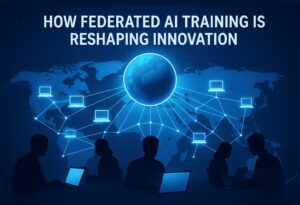
The explosion of artificial intelligence has sparked an insatiable demand for data and processing power—but what’s the tradeoff? For years, massive data centers and cloud-based platforms have been the go-to. Now, a fresh approach is gaining ground. Federated AI training flips the model: it values privacy, lowers costs, and opens doors for broader innovation.
Rather than funneling everything through centralized data hubs, federated training spreads the workload across a network of devices. Each one contributes to the learning process—without ever giving up its raw data. This shift might just be what AI needs to become more fair, efficient, and inclusive.
(See also: Top AI Content Creation Tools Compared: LLaMA and GPT-4.1)
A Clear Shift from Cloud to Crowd
For a long time, training AI meant spinning up thousands of GPUs in centralized facilities—fast, but incredibly costly and out of reach for most. That grip is loosening.
Startups like Flower AI are offering another route. Their open-source tools let developers train models across hundreds, sometimes thousands, of distributed devices. Using federated learning, each participant contributes to a shared model without exposing sensitive data. It’s secure, efficient, and already making waves.
Just recently, Flower launched Collective-1, a large language model that skipped the traditional data center entirely. Volunteers around the world pitched in compute power, proving it’s possible to train big without going big-tech.
(Explore more: Decentralized AI Training Breaks Big Tech Monopoly)
Key Trend: Privacy Comes First
One of the biggest wins with federated AI training? Privacy. In industries like healthcare, banking, and manufacturing, sensitive data can’t just be tossed into a training pool—it’s protected by law.
Federated learning respects that. Data stays put on local machines, and only the insights from training are shared. For example, hospitals can work together on better diagnostic models without swapping patient files. They just exchange model updates.
Cybernews points out that this method is already being embraced by organizations working under strict privacy laws. It opens up valuable datasets that used to be locked away because of legal risk.
Impact on AI Infrastructure and Cost
Let’s talk scale. Traditional AI dev eats up tons of compute, often centered in energy-hungry, high-maintenance server farms. With demand for AI resources doubling every few months, the old model just doesn’t hold up.
Federated training offers a leaner path. Instead of relying on a few powerful systems, developers tap into devices already out in the wild—laptops, edge devices, internal servers. It’s like crowd-sourced computing for AI.
Organizations can cut their hardware budgets dramatically, using what they already have instead of building from scratch. Even better, they’re not beholden to one cloud provider’s pricing or ecosystem.
Power in the Hands of the Many
This isn’t just about cost—it’s about control. Federated AI breaks down the walls around development. Anyone with decent hardware can contribute to model training, no special access required.
Think of it like open-source software. That same spirit of global collaboration is now possible for AI. Flower’s progress shows the theory holds water—they’ve already got it running in the real world.
Rather than reinforcing centralized control, federated learning spreads it out. It reimagines who gets to build AI—and puts tools into more hands.
Expert Insights
“Flower created techniques that allow training to be spread across hundreds of computers connected over the internet. The company’s technology is already used by some firms to train AI models without needing to pool compute resources or data.”
— AI Topics, 2025
“The aspiration for Flower is to change the way the world approaches AI. By simplifying usage of decentralized technologies, like federated learning, a range of advantages over centralized alternatives will be unlocked.”
— Daniel, Taner and Nic, Founders of Flower
Questions of Interest
How does federated learning improve data privacy?
It avoids centralizing sensitive data. Instead, it keeps information on local devices and only shares training results with the global model—reducing the risk of leaks or misuse.
What are the economic benefits of decentralized AI training?
Federated learning slashes the cost of development. It spreads computing across existing devices, eliminates the need for dedicated hardware, and reduces reliance on cloud giants—all while unlocking new data sources.
Wrap-Up
- Federated AI training enables private, efficient model development without centralized data storage.
- It significantly cuts costs and infrastructure requirements by using distributed computation.
- The model supports sensitive sectors with strict data handling regulations.
- Flower’s Collective-1 proves decentralized AI can scale globally and effectively.
Sources and Further Reading
- Flower AI announces Series A and scaling goals:
- https://flower.ai/blog/2024-02-15-announcing-series-a/
- Coverage of federated learning’s enterprise use in AI Topics:
- https://aitopics.org/doc/news:2254A639