Top AI Content Creation Tools Compared, Llama and GPT 4.1

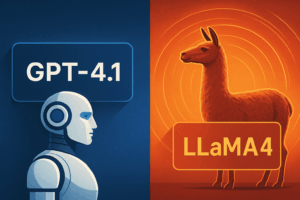
If you’re in the business of building content with artificial intelligence, choosing the right tool can be the difference between streamlined creativity and frustrating roadblocks. The latest wave of AI solutions, like GPT-4.1 and Llama 4, have reshaped what’s possible across writing, coding, and even visual content. As AI content creation tools evolve, independent creators now have powerful choices tailored to their specific needs and technical capabilities.
So which model best serves your workflow—OpenAI’s polished GPT-4.1 or Meta’s versatile Llama 4? It depends on how you plan to use them.
Performance Head-to-Head: GPT-4.1 vs. Llama 4
When it comes to raw brainpower, GPT-4.1 leads the pack. According to benchmark tests from Labellerr and PromptHackers, GPT-4.1 scored 54.6% on SWE-bench—a standard performance test for code-related tasks—beating Llama 4 soundly. It’s especially useful for complex content generation, offering improved support for creative writing, business communications, and technical documents.
On the flip side, Llama 4—particularly the Behemoth and Maverick variants—offers a game-changing 10 million token context window. That’s roughly 10 times more than GPT-4.1. For creators dealing with book-length manuscripts, full podcast transcripts, or detailed how-to guides, this extra capacity can save hours.
While GPT-4.1 may offer sharper responses in short bursts, Llama 4 wins in handling uninterrupted, large-scale content. That makes it a favorite among long-form DIY content makers.
Accessibility and Cost Considerations
Let’s talk dollars and cents. GPT-4.1 has improved its price-performance ratio by about 40% compared to earlier GPT-4 versions. According to Labellerr, OpenAI’s updated pricing structure makes it significantly more affordable for independent creators who previously found advanced models out of reach.
Still, Llama 4 answers a different budget question: what if you could eliminate API costs altogether? Because it’s open-source, this model can be downloaded and run locally on manageable hardware—like a single high-end GPU. If you’re a tech-savvy creator comfortable managing your own setup, you could cut recurring costs to zero. For those without that infrastructure, GPT-4.1 remains the more turnkey solution.
(Related article: AI Agent Frameworks Comparison: CrewAI vs AutoGen)
Key Feature: The Context Window Gap
One standout differentiator between these AI content creation tools is how much information each can keep in memory. GPT-4.1’s 1 million token limit is strong, especially for dialogue or common business use cases. But Llama 4’s 10 million tokens is on another level.
What does that mean in real terms? According to Bind AI Research, Llama 4 can “process entire manuscripts or video transcripts in a single session.” If you frequently work with large data sets, or want an AI assistant that won’t forget earlier parts of your document, Llama 4 is your best bet.
That said, remember that more context isn’t always better unless you know how to harness it effectively. Without a thoughtful workflow, it’s easy for even capable models like Llama 4 to lose track of relevance when juggling large volumes of text.
Customizability and DIY Potential
If “flexibility” sits high on your priority list, Llama 4 has a serious advantage. Its open-source framework lets advanced users fine-tune and customize their own instances. You can shape the model’s focus, integrate it into private apps, or even contribute to its ongoing development.
Meanwhile, GPT-4.1 operates entirely within OpenAI’s cloud platform. While some may view this as restrictive, others appreciate the stability, security, and lower barrier to entry. If your goals revolve around getting high-quality content quickly—without needing system admin skills—GPT-4.1 might still be your best bet.
Ultimately, creators looking to self-host AI or tweak performance on the fly will find Llama 4 much more receptive to experimentation.
(Also read: Top AI Detection Bypass Tools to Watch in 2024)
Expert Insights
“While GPT-4.1 outperforms Scout and Maverick in raw performance metrics, its context window is only 1.28% the size of Llama 4’s 10M token capacity, making Llama 4 significantly more valuable for long-form content creators who need to process entire manuscripts or video transcripts in a single session.” — Bind AI Research Team
“The open-source nature of Llama 4, combined with its competitive performance, challenges the proprietary dominance of models like GPT-4.1, though DIY creators should consider that GPT-4.1’s SWE-bench score of 54.6% represents a massive improvement over previous models for code-heavy content creation.” — Labellerr AI Testing Team
Quick Answers for Creators
Is Llama 4 better than GPT-4.1 for long-form content creation?
Yes—Llama 4 excels at handling massive files thanks to its 10M token context window. GPT-4.1 may feel more responsive on short tasks, but it can’t match Llama 4’s ability to process entire books or in-depth transcripts in a single pass.
Which model is more affordable for content creators?
It depends on your tech setup. GPT-4.1 now offers better efficiency and pricing than ever, ideal for plug-and-play users. Llama 4, if self-hosted, may eliminate usage fees altogether—but it requires technical know-how and local hardware.
Wrap-Up
- GPT-4.1 brings high accuracy and speed to business, coding, and creative tasks.
- Llama 4’s vast context window enables uninterrupted long-form content generation.
- Open-source access makes Llama 4 more customizable, especially for developers.
- GPT-4.1 remains the smarter choice for users wanting easy setup and reliable output.